Phonetics

Introduction to phonetics :Phonetics, they are the sound of spoken language.
Vocal tract

Voiced and Voiceless
What is Voiced?
 A simple explanation of voiced consonants is that they use the voice. This is easy to test by putting your finger on your throat. If you feel a vibration the consonant is voiced. Here is a list of some voiced consonants. Pronounce each consonant sound (not the letter) and feel the vibration of your vocal chords.
What is Voiceless?
Voiceless consonants do not use the voice. They are percussive and use hard sounds. Once again, you can test if a consonant is voiceless by putting your finger on your throat. You will feel no vibration in your throat, just a short explosion of air as you pronounce. Pronounce each of these consonant sounds and feel NO vibration in your throat.
Places and manners of articulation.

Vowels
Vowel is a sound in spoken language, such as an English ah! /ɑː/ or oh! /oʊ/, pronounced with an open vocal tract so that there is no build-up of air pressure at any point above the glottis. This contrasts with consonants, such as English sh! [ʃː], which have a constriction or closure at some point along the vocal tract. A vowel is also understood to be syllabic: an equivalent open but non-syllabic sound is called a semivowel.
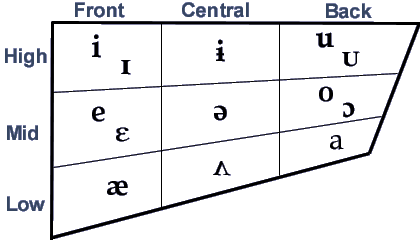
Diphthongs
 Diphthongs often form when separate vowels are run together in rapid speech during a conversation. However, there are also unitary diphthongs, as in the English examples above, which are heard by listeners as single-vowel sounds
Diphthongs contrast with monophthongs, where the tongue or other speech organs do not move significantly and the syllable contains only a single vowel sound. For instance, in English, the word ah is spoken as a monophthong /ɑː/, while the word ow is spoken as a diphthong /aʊ/.
Retroflex Sounds
.svg) A retroflex consonant is a coronal consonant where the tongue has a flat, concave, or even curled shape, and is articulated between the alveolar ridge and the hard palate.
A retroflex consonant is a coronal consonant where the tongue has a flat, concave, or even curled shape, and is articulated between the alveolar ridge and the hard palate.
Rounding Vowels
.svg/2000px-Cardinal_vowel_tongue_position-back(png).svg.png) Vowel roundedness refers to the amount of rounding in the lips during the articulation of a vowel. It is labialization of a vowel. When pronouncing a rounded vowel, the lips form a circular opening, while unrounded vowels (also called spread vowels) are pronounced with the lips relaxed. In most languages, front vowels tend to be unrounded, while back vowels tend to be rounded.
Vowel roundedness refers to the amount of rounding in the lips during the articulation of a vowel. It is labialization of a vowel. When pronouncing a rounded vowel, the lips form a circular opening, while unrounded vowels (also called spread vowels) are pronounced with the lips relaxed. In most languages, front vowels tend to be unrounded, while back vowels tend to be rounded.
No hay comentarios:
Publicar un comentario